
There is a term circulating in SEO and content marketing circles right now: AI slop.
It refers to the wave of low-effort, AI-generated content that has flooded the web since generative AI tools became widely accessible. Thin articles that cover every topic from every angle but say nothing specific. Listicles with no real insight. Guides written at surface level because a prompt asked for 1,500 words and the model delivered exactly that.
The problem for marketers who want to rank in both traditional search and AI-generated answers is significant: AI search systems are actively getting better at detecting and deprioritizing this content.
Quality has always mattered in SEO. In the GEO era, it is the primary filter standing between your content and a citation.
What “AI Slop” Actually Is
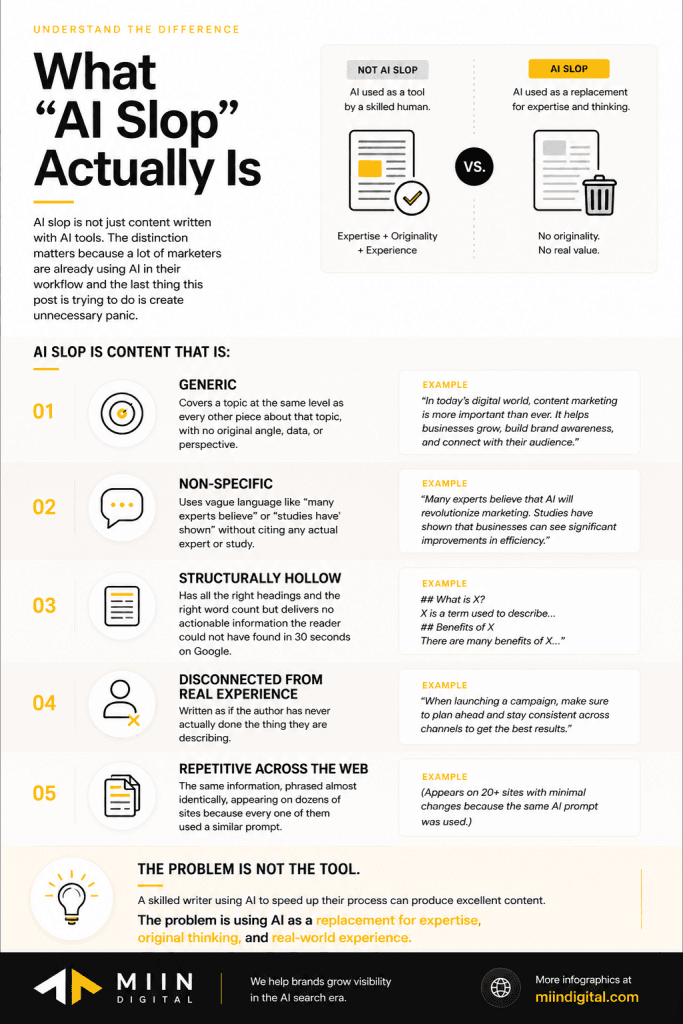
AI slop is not just content written with AI tools. The distinction matters because a lot of marketers are already using AI in their workflow and the last thing this post is trying to do is create unnecessary panic.
AI slop is content that is:
- Generic: Covers a topic at the same level as every other piece about that topic, with no original angle, data, or perspective
- Non-specific: Uses vague language like “many experts believe” or “studies have shown” without citing any actual expert or study
- Structurally hollow: Has all the right headings and the right word count but delivers no actionable information the reader could not have found in 30 seconds on Google
- Disconnected from real experience: Written as if the author has never actually done the thing they are describing
- Repetitive across the web: The same information, phrased almost identically, appearing on dozens of sites because every one of them used a similar prompt
The problem is not the tool. A skilled writer using AI to speed up their process can produce excellent content. The problem is using AI as a replacement for expertise, original thinking, and real-world experience.
Why AI Search Systems Are Getting Better at Filtering It Out
This is the part most content creators have not fully reckoned with yet.
AI search systems like Perplexity, ChatGPT with browsing, and Google’s AI Overviews do not just retrieve the most popular pages. They try to retrieve the most trustworthy, specific, and accurate sources available. The signals they use to make that judgment are increasingly sophisticated.
Several things are happening simultaneously:
Google’s quality systems have been explicitly targeting unhelpful content. The helpful content updates of the past few years have specifically targeted content written primarily for search engines rather than for human readers. Pages that had no original value, even if they were technically well-optimized, have seen significant ranking drops. This affects what gets indexed and surfaced to AI systems in the first place.
AI models can recognize patterns of AI-generated text. This is not about AI detectors, which are unreliable and not something to obsess over. It is about the fact that the same models that generate AI content were trained on human-written text and can recognize when content lacks the specificity, variation, and genuine perspective that characterizes writing from real experience.
Retrieval systems favor specificity and extractable data points. When an AI search system is deciding which source to cite in its answer, it looks for content that contains precise, verifiable, useful information. Generic content cannot win this competition because it offers nothing specific enough to extract.
The web is saturating on common topics. There are now thousands of blog posts titled “What is SEO?” that say essentially the same thing. AI systems are learning which sources to trust on a given topic based on patterns of citation, expertise signals, and content depth. If your content is indistinguishable from the other 999 posts on the same topic, it will not be the one that gets cited.
What Real Quality Looks Like in 2026
Quality is not about length. It is not about reading level. It is not about whether the content was written by a human or with AI assistance. Here is what it actually means:
Specificity Over Generality
A post that says “email open rates vary by industry” is less useful than a post that says “in B2B SaaS, the average email open rate in 2025 was around 32%, compared to 21% in e-commerce, according to Mailchimp’s annual benchmark report.”
The second version gives the reader an actual number, a specific context, and a source. AI search systems can extract that and use it. They cannot do anything useful with the first version.
Every claim you make in your content should be as specific as the available evidence allows. If you do not have a specific number, cite why and offer a range. Precision is a quality signal.
Original Perspective Over Summarized Consensus
The web has enough summaries. What it does not have enough of is people who have actually done things, sharing what they actually found.
If you have run email campaigns, write about what you specifically observed. If you have built a content strategy for a real client, document what worked and what did not. If you have run a prompt test across AI search tools for your own site, publish the results.
This is what no AI tool can produce on its own, because it does not exist yet. Original experience and perspective are the one content asset that cannot be replicated at scale.
Genuine Helpfulness for a Specific Audience
The question to ask before publishing anything is: could someone read this and do something they could not do before?
If the answer is no because the content is too vague, too general, or too obvious for the audience it claims to serve, it is not genuinely helpful. If the answer is yes because it gives the reader a specific framework, a concrete checklist, a real example, or a piece of information they did not have before, it is.
Genuine helpfulness is not about word count or effort. It is about the gap between what the reader knew before they read your post and what they know after.
Clear Attribution and Sourcing
One of the clearest signals of low-quality AI content is the absence of any real sources. Real experts cite their data. Real researchers link to original studies. Real practitioners reference the tools and resources they actually use.
Get into the habit of linking to primary sources whenever you reference data or make a factual claim. Not to other blog posts that cite the same data, but to the original study, report, or platform where that information comes from.
This is both good content practice and a direct GEO signal. AI systems are trained to trust sources that behave like credible sources behave.
The Workflow Problem: Why Teams Produce Slop Even When They Know Better
Here is something most posts on this topic skip: the reason a lot of mediocre content gets published is not because the people producing it do not know better. It is because the content production process is chaotic enough that quality checks get skipped under deadline pressure.
A content manager is handling 10 posts this month. A writer submits something that is fine but not great. There is no clear process for what “great” looks like or how to get there from “fine.” The post goes out. Multiply that across 12 months and you have a content archive full of mediocre material that is dragging your GEO performance down.
The practical solution is building a quality checklist into your content workflow, not leaving quality as a subjective judgment call at the end.
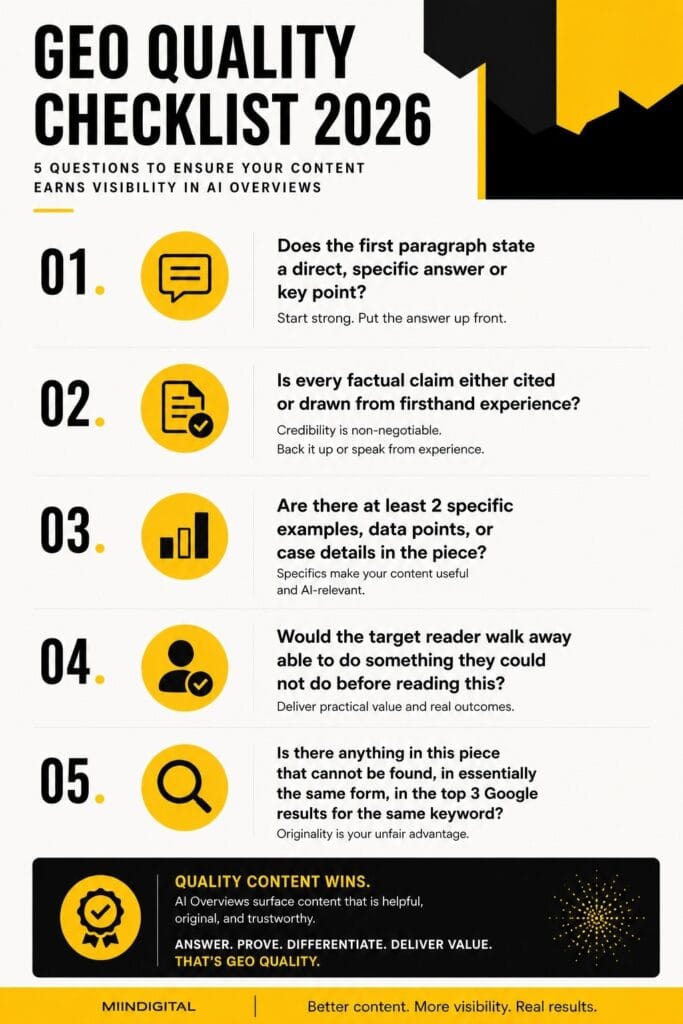
Before any piece of content is published, someone should be checking:
- Does the first paragraph state a direct, specific answer or key point?
- Is every factual claim either cited or drawn from firsthand experience?
- Are there at least 2 specific examples, data points, or case details in the piece?
- Would the target reader walk away able to do something they could not do before reading this?
- Is there anything in this piece that cannot be found, in essentially the same form, in the top 3 Google results for the same keyword?
If the answer to that last question is no, the piece needs more work before it is published. No exceptions.
If you are managing content production across a team, having a shared system to track drafts, assign reviews, and flag quality issues before publication makes a real difference in the consistency of what goes out. MiinPlanner, which you can use free at planner.miindigital.com, is built for exactly this kind of small team workflow. Assign posts as tasks, add the quality checklist as subtasks, and use the AI-powered planning features to keep your editorial calendar on track without things slipping through.
How to Audit Your Existing Content for Quality Issues
If you have been publishing for a while, some of your older content is probably below the standard described above. That is not a reason to panic. It is a reason to prioritize a content audit.
Here is how to approach it:
Step 1: Pull your content list from Google Search Console Look at all pages that have received at least some impressions in the past 3 months. Sort by impressions. Start with the highest-impression pages that have low click-through rates and low or declining average positions.
Step 2: Run each page through the quality checklist above Be honest. If a page fails two or more of the five checks, it needs work.
Step 3: Decide: improve, consolidate, or remove
- Improve: Pages that cover the right topic but lack depth, specificity, or original perspective. These are worth updating.
- Consolidate: Multiple thin pages covering essentially the same topic. Merge them into one comprehensive post and redirect the others to it.
- Remove (or noindex): Pages with no search visibility, no original value, and no realistic path to either. Keeping them on the site adds nothing and can dilute your overall content quality signals.
Step 4: Update the best candidates first Prioritize pages that are close to ranking. A page at position 12 for a competitive keyword that needs a quality upgrade is a better investment than starting a new page from scratch on the same topic.
The Honest Take on AI Tools in Content Production
AI writing tools are not going away. The marketers who treat them as a shortcut to skip the hard parts of content production will produce slop and lose visibility. The marketers who use them as a force multiplier for genuine expertise will move faster and still produce original, citable content.
The distinction in practice:
Using AI well: Research assistance, generating outline options, drafting sections you then rewrite with your own perspective, creating variations of a headline, cleaning up awkward sentences.
Using AI poorly: Generating a complete post from a single prompt and publishing it with minimal review, using AI to produce content on topics you have no real expertise in, treating AI output as a first draft that is already close enough to publish.
The test is simple: if you removed every element of original insight, firsthand experience, specific data, and genuine perspective from a piece of content, and nothing was left, it was not adding real value to begin with.
The content that gets cited in AI search results in 2026 is the content that would have been worth citing in any era. Quality was always the answer. It has just become easier to measure how well you are delivering on it.
The MiinDigital Clear Text Formatting Tool strips all formatting from pasted text in one click, giving you clean plain text to work with in your editor. It takes three seconds and avoids the kind of invisible formatting issues that can affect how search engines and AI systems parse your content.
Similarly, before publishing, use the Word and Character Counter to check that your meta description, title tag, and key sections are the right length. These small habits compound into a cleaner, more consistently optimized content archive over time.
Related Guides in This Series
- SEO + GEO Complete Guide for Digital Marketers
- What is GEO? Generative Engine Optimization, Explained Simply
- How to Write Content That AI Cites
- Which AI Search Platform Should You Optimize For? (coming soon)
- How Search Intent Has Changed in the AI Era (coming soon)
- Entity SEO: How to Make Sure AI Knows Who You Are (coming soon)
This post contains affiliate links. If you purchase through these links, MiinDigital may earn a small commission at no extra cost to you.
Part of the SEO + GEO Guide series on MiinDigital. Need help auditing your content for quality and GEO readiness? Get in touch.
Published: April 2026 | Author: Minh Pham
Leave a Reply
You must be logged in to post a comment.