
There is a layer of GEO optimization that most content guides skip over entirely: entity authority.
It is not about keywords, headings, or content structure. It is about whether AI systems and search engines have a clear, consistent, trustworthy picture of who you are, what you do, and what topics you are genuinely authoritative on.
Without that picture, your content can be perfectly written and still get passed over in favor of a source the system knows and trusts. Entity SEO is how you build that trust at the identity level, not just the content level.
What Is an Entity?
In the context of search and AI systems, an entity is any distinct, identifiable thing that can be described and distinguished from other things. People, businesses, places, products, concepts, and organizations are all entities.
Your business is an entity. You as an author are an entity. The topics you cover are entities. The tools and brands you reference are entities.
Search engines and AI systems build knowledge about entities by collecting information from across the web: your website, your social profiles, mentions in other publications, structured data you have added to your pages, and the overall pattern of how you are described and referenced online.
When a search system has a rich, consistent, well-sourced picture of an entity, it trusts that entity more. When the picture is sparse, inconsistent, or absent, the entity gets lower trust scores regardless of how good its content is.
For small businesses and independent publishers, entity authority is one of the most underleveraged opportunities in SEO and GEO.
Why Entity Authority Matters More in AI Search
Traditional search relied heavily on keyword matching and link authority. Entity recognition was a factor, but content and links could compensate for a weak entity presence.
In AI search, entity authority plays a more central role for two reasons.
First, AI systems try to identify the source of every piece of content they retrieve, not just the content itself. When Perplexity or Google’s AI Overview decides whether to cite a source, it is making a judgment about the source as an entity, not just about the page. A well-recognized entity with consistent signals across the web gets more trust than an anonymous or inconsistently described one.
Second, AI language models are trained on vast amounts of web content that describes, references, and discusses entities. If your brand or author name appears frequently, consistently, and in credible contexts across that training data, the model already has a positive prior toward trusting your content. If your entity barely exists in training data, the model has no prior to draw on.
This is why established publications and recognized experts appear so consistently in AI search citations. Their entity authority was built over years before GEO was even a concept. Building yours now is how you close that gap.
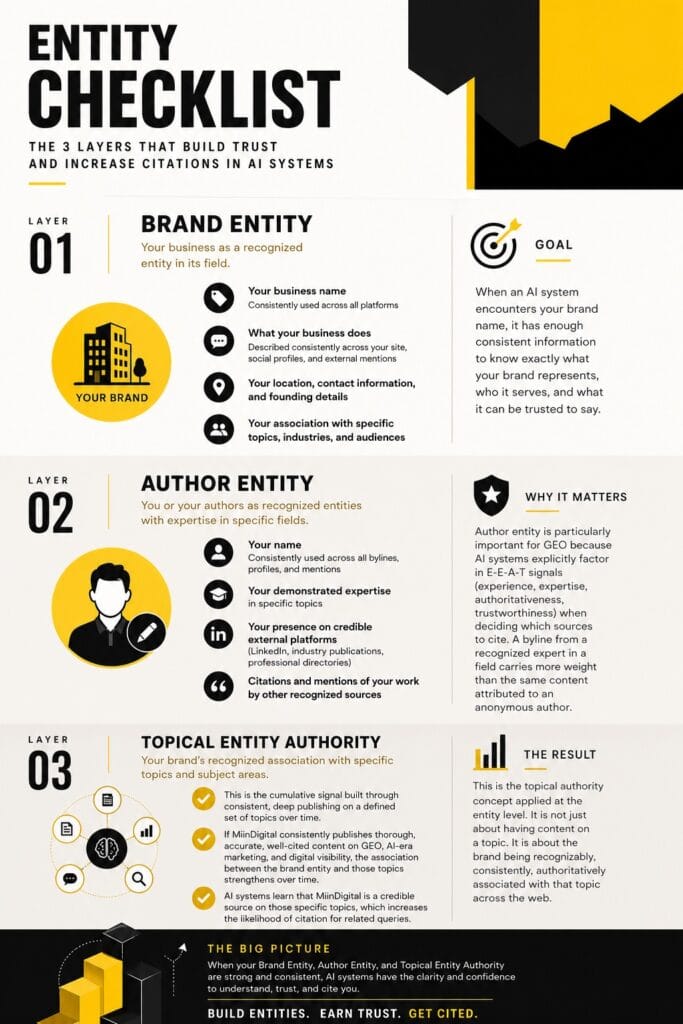
The Three Layers of Entity Authority
Entity authority for a content-publishing business or independent marketer operates at three levels. You need to work on all three.
Layer 1: Brand Entity
Your business as a recognized entity in its field. This includes:
- Your business name, consistently used across all platforms
- What your business does, described consistently across your site, social profiles, and external mentions
- Your location, contact information, and founding details
- Your association with specific topics, industries, and audiences
The goal is that when an AI system encounters your brand name, it has enough consistent information to know exactly what your brand represents, who it serves, and what it can be trusted to say.
Layer 2: Author Entity
You or your authors as recognized entities with expertise in specific fields. This includes:
- Your name, consistently used across all bylines, profiles, and mentions
- Your demonstrated expertise in specific topics
- Your presence on credible external platforms (LinkedIn, industry publications, professional directories)
- Citations and mentions of your work by other recognized sources
Author entity is particularly important for GEO because AI systems explicitly factor in E-E-A-T signals (experience, expertise, authoritativeness, trustworthiness) when deciding which sources to cite. A byline from a recognized expert in a field carries more weight than the same content attributed to an anonymous author.
Layer 3: Topical Entity Authority
Your brand’s recognized association with specific topics and subject areas. This is the cumulative signal built through consistent, deep publishing on a defined set of topics over time.
If MiinDigital consistently publishes thorough, accurate, well-cited content on GEO, AI-era marketing, and digital visibility, the association between the brand entity and those topics strengthens over time. AI systems learn that MiinDigital is a credible source on those specific topics, which increases the likelihood of citation for related queries.
This is the topical authority concept applied at the entity level. It is not just about having content on a topic. It is about the brand being recognizably, consistently, authoritatively associated with that topic across the web.
How to Build Your Brand Entity
1. Claim and Complete Your Google Business Profile
Google’s Knowledge Panel, which appears in search results when someone searches your brand name directly, is built largely from your Google Business Profile. If you do not have one, create it. If you do, make sure every field is complete and accurate.
Your GBP is one of the clearest entity signals Google uses to understand your business. An incomplete or unclaimed profile leaves a gap in the picture the system builds about you.
2. Be Consistent With Your Brand Name Everywhere
Pick the exact form of your brand name and use it identically across every platform: your website, social profiles, directory listings, email signatures, guest post bylines, and external mentions.
Inconsistency in your brand name creates fragmentation in how search systems identify and aggregate information about your entity. “MiinDigital,” “Miin Digital,” and “miindigital.com” are three slightly different strings. Consistency collapses them into one clearly recognized entity.
3. Add Structured Data to Your Website
Structured data is code you add to your pages that explicitly tells search engines about your entity. For a business, the most important structured data types are:
- Organization schema: Defines your business name, URL, logo, contact information, social profiles, and founding details
- Person schema: Defines individual authors with their name, expertise, credentials, and associated profiles
- WebSite schema: Helps search engines understand your site structure and search functionality
- BreadcrumbList schema: Clarifies the organizational structure of your content
Adding structured data does not require a developer if you are on WordPress. Plugins like RankMath and Yoast SEO handle the most important schema types through their settings panels.
4. Build a Consistent Presence Across Authoritative Platforms
Your entity is strengthened every time a credible external source describes your brand consistently and links to your site. The platforms that contribute most to entity recognition:
- LinkedIn: Your company page and personal profile are among the most trusted professional entity signals. Keep them complete and current.
- Crunchbase: Free company profile on a highly trusted platform with strong domain authority.
- Wikipedia: If your brand or the topics you cover have Wikipedia pages, the information there directly feeds Google’s Knowledge Graph. You cannot create a Wikipedia page about your own business (conflict of interest policies), but contributing accurate information to related pages builds topical association.
- Wikidata: The structured data layer behind Wikipedia. More obscure but directly connected to Google’s Knowledge Graph. If you or your brand meet notability criteria, a Wikidata entry is worth pursuing.
- Industry directories and associations: Membership in recognized industry associations and presence on relevant professional directories adds entity credibility specific to your field.
5. Earn Mentions and Citations From Recognized Sources
Every time a credible publication mentions your brand, quotes you as an expert, or links to your content, that mention reinforces your entity signals. The quality and relevance of the mentioning source matters significantly.
A mention in a recognized digital marketing publication contributes more to your entity authority than a mention on a low-traffic personal blog, because the AI system can recognize the mentioning source as credible and weight the association accordingly.
This is why guest posting on genuinely respected sites matters beyond the backlink itself. The association between your entity and a trusted publishing platform is an entity signal.
How to Build Your Author Entity
Use a Consistent Author Name on Every Byline
Every post you publish on your own site, every guest post, every forum contribution, and every social media profile should use the same form of your name. Variations fragment your author entity the same way brand name variations fragment your brand entity.
Create a Dedicated Author Page on Your Site
Your author page should include:
- Your full name
- A clear description of your expertise and background relevant to your topics
- Links to your professional profiles (LinkedIn, Twitter/X, other relevant platforms)
- A list of your published work on the site
- Any notable external publications, mentions, or credentials
This page becomes a hub that search systems can reference when building your author entity profile.
Build External Author Presence
Your author entity is strengthened by appearances outside your own site. In order of impact:
- Guest posts on respected industry publications with a byline linking back to your site or author page
- Expert quotes in articles published by recognized media or industry sites
- Podcast guest appearances where you are identified by name and linked
- Profiles on professional platforms (LinkedIn, industry associations, professional directories)
- Social media profiles where you consistently publish on your topic
The goal is a consistent pattern of your name, your expertise, and your site appearing together across credible external sources.
Cite Your Own Experience Specifically
One of the strongest author entity signals for AI systems is content that demonstrates genuine firsthand experience. When you write about something you have actually done, include specifics: numbers, outcomes, tools you used, mistakes you made, decisions you took.
This specificity is difficult to fabricate and relatively easy for AI systems to distinguish from generic, experience-free content. It also directly builds the “experience” component of E-E-A-T, which Google and AI systems explicitly use to evaluate source quality.
How to Build Topical Entity Authority
Publish in Clusters, Not in Isolation
Topical entity authority is built through a pattern of consistent, deep content on a defined set of topics. A single strong post on GEO does not establish you as a GEO authority. A pillar page plus eight spoke posts plus two gap posts plus ongoing updates creates a pattern that AI systems recognize.
This is the content cluster strategy applied at the entity level. The goal is not just good individual pieces. It is a recognizable body of work on specific topics.
Cover Topics at Multiple Depths
AI systems recognize topical authority in part through the range of related topics a source covers. If you publish on GEO, you should also cover the adjacent topics that form the full knowledge landscape around it: how AI search works, intent in AI search, measuring GEO performance, platform-specific GEO, entity SEO.
Covering the full topical map at different depths signals that your expertise is genuine and broad within the domain, not limited to one narrow angle.
Update and Maintain Your Most Important Content
Topical authority is not just about how much you have published. It is about the currency and accuracy of what you have published. Outdated content on your core topics weakens your topical entity signal because AI systems increasingly deprioritize stale information.
Set a quarterly review schedule for your most important posts. Update statistics, refresh examples, and add sections that address new developments in the topic. A clearly maintained content archive signals ongoing commitment to the topic.
Tools for Monitoring Your Entity Presence
Google Search Console: Check whether Google has generated a Knowledge Panel for your brand by searching your exact business name in Google. If a panel appears, your entity is recognized. If not, strengthening the signals above will eventually trigger one.
SEMrush: SEMrush has strong tools for monitoring brand visibility across both traditional search and AI-generated results. Its Brand Monitoring and Position Tracking features help you see how your entity is represented in search results over time, and its emerging AI visibility features track your citation presence across AI search tools. It is the most comprehensive option for entity and AI visibility monitoring available.
SE Ranking: SE Ranking includes brand monitoring and SERP tracking features that help you identify when and where your brand is appearing in search results, including AI-influenced results. A practical choice if you want entity monitoring bundled with your existing rank tracking and audit workflow.
Mangools SiteProfiler: Mangools SiteProfiler gives you a clear view of your domain authority, backlink profile, and how your site compares to competitors on trust and citation signals. Useful for understanding where your brand entity stands relative to sources you want to compete with for AI citations.
Google Alerts: Set up alerts for your brand name, your author name, and your core topic keywords. Every mention of your brand across the web is an entity signal. Knowing when and where those mentions appear helps you identify both opportunities and inconsistencies in how your entity is being described.
Wikidata and Wikipedia search: Search your brand name and your author name directly on both platforms. If entries exist, verify the information is accurate. If they do not exist but you meet notability criteria, adding entries (following each platform’s guidelines carefully) is a direct Knowledge Graph signal.
A Practical Entity Audit
Run through this checklist to assess where your entity presence currently stands and where the highest-priority gaps are:
Brand entity:
- Google Business Profile is claimed, complete, and accurate
- Brand name is identical across your website, all social profiles, and all directory listings
- Organization schema is implemented on your website homepage
- Your brand appears in a Google Knowledge Panel when your exact name is searched
- Your brand is listed on Crunchbase, LinkedIn company page, and relevant industry directories
Author entity:
- Every post on your site has a named author (not “admin” or “team”)
- A dedicated author page exists with credentials, expertise, and links to external profiles
- Person schema is implemented on your author page
- Your author name is consistent across your site and all external bylines
- Your author profile exists and is complete on LinkedIn
Topical entity:
- You have published at least 5 interconnected pieces of content on each core topic cluster
- Your most important posts link to each other in a clear hub-and-spoke structure
- You have at least one external publication or mention for each of your core topics
- Your most important posts have been reviewed and updated within the past 12 months
If you score below 10 out of 15, entity building is a higher priority right now than publishing new content. Strengthen the foundation before adding more pages.
The Long Game
Entity authority is not built in a month. It is the cumulative result of consistent publishing, consistent brand presence, consistent external citations, and consistent accuracy over time.
The sites and authors that appear most reliably in AI search citations are not there because they optimized harder in one sprint. They are there because they spent years building recognizable, trustworthy, consistent entity signals before anyone was calling it GEO.
Starting that work now, even from a small base, is the right decision. The signals compound. A brand that spends 12 months building entity authority will be significantly better positioned in AI search than one that does nothing for those 12 months, regardless of how much content both sites publish.
Entity authority is the long game. It is also, increasingly, the only game that produces durable AI search visibility.
Related Guides in This Series
- SEO + GEO Complete Guide for Digital Marketers
- How AI Search Actually Works
- What is GEO? Generative Engine Optimization, Explained Simply
- How to Write Content That AI Cites
- AI Slop vs. Real Content: Why Quality Has Never Mattered More for GEO
- How to Test Whether AI Search Can Find You (coming soon)
- Local Business GEO (coming soon)
Part of the SEO + GEO Guide series on MiinDigital. Want help building entity authority for your brand? Get in touch.
Published: April 2026 | Author: Minh Pham
Leave a Reply
You must be logged in to post a comment.